
Generate
Create IPFIX flow records
Configure collector address and protocol, observation identity, flow timeouts, and reporting behavior for the traffic entering the generator.
IPFIX GeneratorFlow-Records / NetFlow and IPFIX
Generate flow records from observed traffic, process existing exporter feeds, and deliver telemetry through a controlled service path. 01Layer brings generation, template handling, transport conversion, and collector delivery together in NextIO.
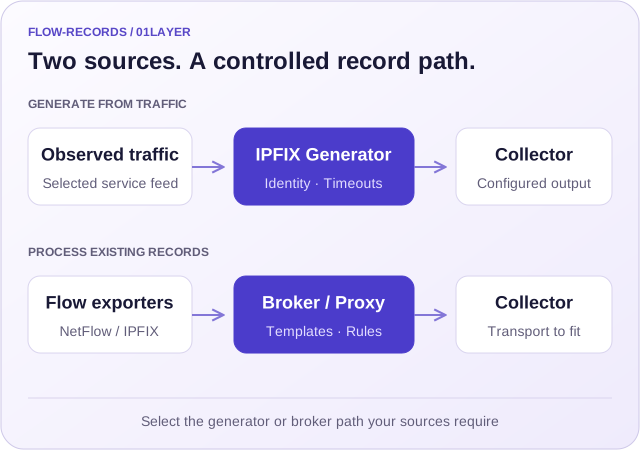
Create flow records from a selected traffic feed.
Apply template-aware processing and configured transport handling.
Define record format, addressing, transport, and downstream delivery.
Two starting points
Choose a generator when the service starts from observed traffic. Choose a broker or proxy when upstream systems already produce NetFlow or IPFIX. Each role has its own controls.
Generate
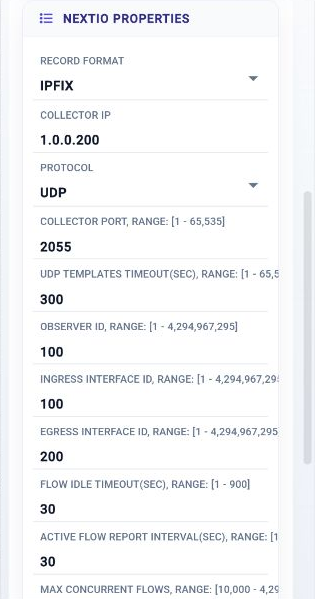
Configure collector address and protocol, observation identity, flow timeouts, and reporting behavior for the traffic entering the generator.
IPFIX GeneratorProcess
Use the NetFlow Proxy to process and edit flow records with template limits, field dictionaries, and a rules database.
NetFlow ProxyEnrich the feed
DNS to JSON produces DNS telemetry as JSON or NetFlow/IPFIX records. Define collector delivery and DNS validation behavior for the service.
DNS to JSONReporting controls
The IPFIX Generator exposes both collector delivery and flow lifecycle settings. These choices determine when a record is emitted and how a collector identifies the observation point.
Template-aware processing
Templates define the structure of NetFlow/IPFIX data. The processing path needs an explicit policy for template lifetime, unknown templates, and the fields it accepts.
| Control | Purpose | Operator check |
|---|---|---|
| Template lifetime and capacity | Set expiry time, maximum templates, and maximum fields per template. | Match expected exporter behavior and template refresh frequency. |
| Missing-template policy | Choose whether to drop a flow set when its template is unavailable. | Test exporter restart and collector reconnect scenarios. |
| Record verification | Use the configured template verification and field dictionary. | Confirm that downstream systems decode the intended fields. |
| Rules database | Select the rules used to process or edit flow records. | Compare representative input records with delivered output. |
| Non-flow traffic | Choose the handling of traffic that is not recognized as NetFlow. | Check that the source selection and drop policy agree. |
Transport that fits the route
The NetFlow/IPFIX service can extract records from TCP payloads, prepare UDP transport, and deliver records onward unchanged or converted back to TCP.
NetFlow TCP Server defines the listening port, framing structure, maximum connections, and conversion buffer. NetFlow TCP Client defines the receiving server address and port.
Use these components around the configured record-processing path when exporter and collector transport requirements differ.
TCP transport componentsIPFIX Message Broker extracts complete records and preserves the structure needed by collectors. The service can hand records to a UDP/Data Diode stage, with optional encryption and decryption.
The destination sender passes records onward or restores TCP delivery as required by the collector.
IPFIX Message BrokerTemplate refresh and successful collector decoding must be validated across the complete path, including any one-way or transport-conversion stage.
Operational workflow
Keep generation settings, proxy behavior, and collector expectations aligned as the service grows.
Select observed traffic for a generator, or identify the exporter connection and record format for a broker or proxy.
Configure observation identity, timeouts, template handling, processing rules, ports, and any conversion or one-way stage.
Connect the required components, save the design, and run verification before starting or applying the service.
Check volume, record fields, template refresh, collector decoding, and activation behavior. Use captured evidence when transport or parsing needs investigation.
Keep exploring
Open the function descriptions, component controls, and related workflows behind this capability.
Discuss the sources, service requirements, and deployment that fit your operation.