UDP
Connect existing emitters
Accept one-message datagrams from devices that use UDP Syslog. Size receive buffers for expected bursts and use visible drop counters to understand best-effort delivery.
Syslog functionLogs / Collection and intelligence
Collect Syslog at the site, make it searchable, and send the events that matter to your central tools. 01Layer brings intake, parsing, local retention, and selective delivery into one operating environment.
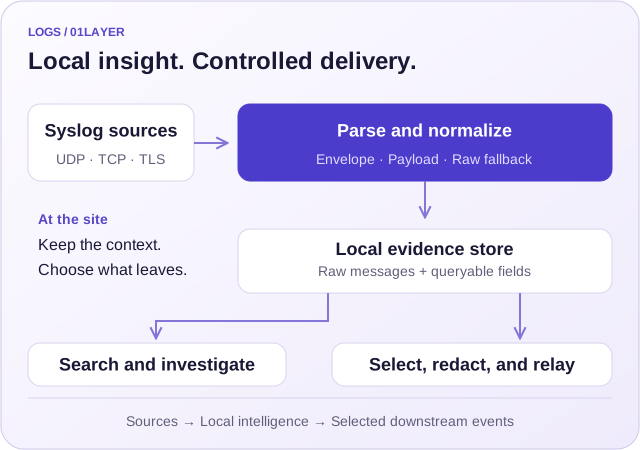
Search local events as they arrive, without waiting for downstream ingestion.
Retain original messages alongside normalized fields and parser context.
Apply filtering, redaction, and routing to downstream delivery.
Flexible intake
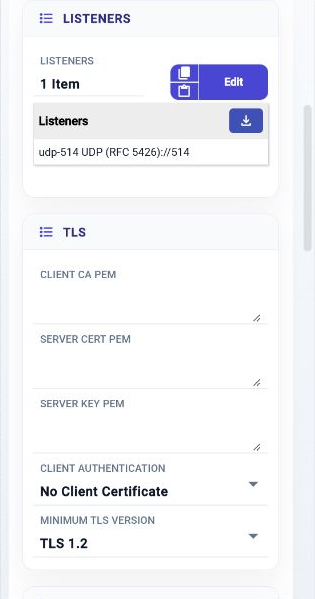
Syslog Collector & Message Broker accepts legacy and modern event streams. Listener configuration defines transport, source access, message framing, and the limits used to receive each feed.
UDP
Accept one-message datagrams from devices that use UDP Syslog. Size receive buffers for expected bursts and use visible drop counters to understand best-effort delivery.
Syslog functionTCP
Receive stream-based logs with RFC 6587 octet-counting or LF, NUL, and CRLF delimiters. Octet-counting keeps embedded newlines from splitting a message.
Broker controlsTLS / mTLS
Configure server certificates, client CA material, client authentication, and the accepted TLS version. Preserve TLS peer identity separately from the hostname claimed inside the event.
Listener propertiesTransparent processing
Parse RFC 5424 and RFC 3164 envelopes, then inspect the message body with CEF, LEEF, JSON, key-value, or selected vendor profiles. Tolerant parsing and raw fallback keep non-conforming input visible.
The invalid-message policy and raw-fallback behavior are configurable. Review sample messages before deciding whether a parser failure should pass through or be dropped.
Local evidence and analytics
The local store keeps normalized columns and raw evidence available for investigation. Search by time, source, host, severity, facility, application, payload type, parse status, or message text.
Use search, DuckDB SQL, notebooks, and dashboards to investigate a time window or a recurring event pattern. Add source, site, zone, and host context so the result can be compared with flow and traffic evidence.
Export CSV, JSONL, or Parquet when an investigation needs a portable dataset for an audit, notebook, or incident review.
Apply disk quotas and separate schedules for raw and parsed data. Retention can follow listener, source, severity, payload type, or site.
Review disk use and the retained time horizon alongside event volume. A useful retention policy preserves the evidence required for the expected investigation window.
Controlled forwarding
Connect collection to the delivery path that matches your central monitoring or security workflow.
| Path | Use it for | How it operates |
|---|---|---|
| Syslog relay | Existing log receivers | A Syslog sender defines destination transport, receiver address, port, and message rendering. Confirm framing and decoding at the receiver. |
| Approved analytics sink | Central SIEM or HTTP ingestion | Apply source, severity, filtering, and redaction rules before forwarding selected events. Validate the receiving format and route. |
| Kafka across a one-way boundary | Segmented log and telemetry pipelines | Kafka Message Broker and Sender prepare and reconstruct events around a Data Diode path, with optional encryption and destination-side secured publishing. |
| Evidence export | Case review and offline analysis | Export a scoped dataset in CSV, JSONL, or Parquet, keeping the source and time range with the findings. |
One-way transfer uses the dedicated Data Diode service design. A normal Syslog or Kafka connection alone does not establish a one-way boundary.
From intake to delivery
A useful log service shows both event content and the health of the path carrying it.
Set transports, ports, source allowlists, connection limits, certificates, and maximum message size.
Run representative RFC, vendor, multiline, and malformed samples through the selected parsers. Review timestamps, raw fallback, and normalized columns.
Choose raw and parsed retention, redaction rules, severity or facility filters, and the destination for each selected event class.
Review event and byte rates, source inventory, drops, parse quality, queue pressure, disk use, and downstream receipt before expanding the feed.
Keep exploring
Open the function descriptions, component controls, and related workflows behind this capability.
Discuss the sources, service requirements, and deployment that fit your operation.